Q1: Derive the formula for the volume of a sphere
$$ \begin{aligned} V &=\int dV \\ &= \int r^2\sin\theta dr d\theta d\phi\\ &=\frac{1}{3} r^3|_{0}^{r} \times (-\cos\theta)|_{0}^{\pi}\times 2\pi\\ &=\frac{4}{3}r^3 \end{aligned} $$$r^2\sin\theta$: it can also be derivative form Jacobi formula.
Curvilinear Coordinates
Spherical polar coordinates (SPC):
review
- 4 types integrate
- Curvilinear Coordinates
- $dl$, $dl_\theta$, $dl_\phi$ 对球坐标和柱坐标
Derivatives in SPC
1. Gradient in the SPC
Definition of the gradient:
$$ df \equiv \frac{\partial f}{ \partial r} dr+ \frac{\partial f}{ \partial \theta} d\theta + \frac{\partial f}{ \partial \phi } d\phi $$We define $\nabla f$ as
$$ df = \nabla f \cdot d\bold{l} = \nabla f \cdot ( dl_r \hat{r} + dl_\theta \hat{\theta} + dl_\phi \hat{\phi}) $$because $dl$ defined as
$$ d\bold{l} \equiv dl_r \hat{r} + dl_\theta \hat{\theta} + dl_\phi \hat{\phi} = \hat{r} dr + \hat{\theta}\sin\theta d\theta + \hat{\phi} r\sin\theta d\phi $$To meet the definition of $df$,
$$ \nabla f = \frac{\partial f}{ \partial r} \hat{r}+ \frac{1}{r}\frac{\partial f}{ \partial \theta} \hat{\theta} + \frac{1}{r\sin\theta} \frac{\partial f}{ \partial \phi} \hat{\phi}\\ = \frac{1}{h_1} dr + \frac{1}{h_2}d\theta + \frac{1}{h_3}d\phi $$2. Divergence in the SPC
To get
$$ \nabla \cdot \bold{A} $$We need start from: $\int (\nabla \cdot \bold{A}) dV = \int_{\partial V} \bold{A} \cdot d\bold{S}$
-
$dS_z=\hat{x}dx \times \hat{y} dy=dxdy\hat{z}$
-
So for a small cubic: $dS=dl_\phi dl_\theta\hat{r}+dl_r dl_\phi \hat{\theta} + dl_r dl_\theta\phi$
From the $\int \nabla \cdot \bold{A} dV = \int \bold{A} \cdot d\bold{S}$, we get $\nabla \cdot \bold{A} = \frac{1}{dV}(\bold{A} \cdot d\bold{S})$
2.
$$ \bold{A} \cdot d\bold{S} = \Delta_r(A_r dl_\theta dl_\phi) + \Delta_\theta(A_\theta dl_r dl_\phi) + \Delta_\phi (A_\phi dl_\theta dl_r) $$- 第一项是穿过$\theta \phi$ 面的通量
Then
$$ \nabla \cdot \bold{A} = \frac{1}{h_1h_2h_3} \left[\frac{\partial (A_r h_2 h_3)}{ \partial r} +\frac{\partial (A_\theta h_1 h_3)}{ \partial \theta} + \frac{\partial (A_\phi h_1h_2)}{ \partial \phi} \right] $$Eg.
$$ \frac{1}{h_1h_2h_3} \frac{\partial A_rh_2h_3}{ \partial r} = \frac{1}{r^2\sin\theta} \frac{\partial \frac{1}{r^2} r^2\sin\theta}{ \partial r} =\frac{1}{r^2} \frac{\partial A_r r^2}{ \partial r} $$3. Curl in the SPC
矢量场中一个方向的分量和另外两个坐标有关,和标量场不同。比方说,沿着$y$ 轴向上,只有$y$ 在变,而此时,$x$ 方向的电场会变小。
To get $\nabla \times \bold{A}$, we start from
$$ \int (\nabla \times \bold{A}) \cdot d\bold{S} = \oint_{\partial S} \bold{A} \cdot d\bold{l} $$我们先只写 $r$ 方向的分量:
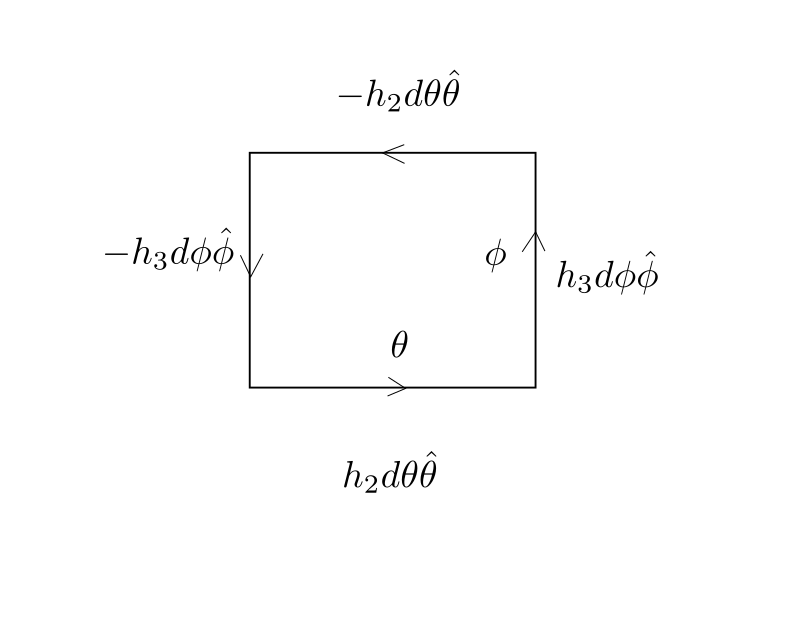
$$ (\nabla \times \bold{A})_r = \frac{\bold{A}\cdot d\bold{l}}{dS}=- \frac{\Delta_\phi(A_\theta h_2) }{h_2h_3d\phi} + \frac{\Delta_\theta(A_\phi h_3)}{h_2h_3d\theta} $$
- here the $dS=h_2h_3 d\theta d\phi$, which is a scalar.
So, curl in SPC
$$ \nabla \times \bold{A} = \frac{1}{h_1h_2h_3} \begin{pmatrix} h_1\hat{r} & h_2\hat{\theta} & h_3\hat{\phi}\\ \partial_r & \partial_\theta & \partial_\phi\\ h_1A_r & h_2A_\theta & h_3A_\phi \end{pmatrix} $$Q2: Find the formula of curl in the spherical polar coordinate
$$ \nabla \times A = $$Dirac Delta Function
Consider the vector function $v=\frac{1}{r^2} \hat{r}$, from the very begin (problem 1.16): $$ \begin{aligned} \nabla \cdot \bold{v} &= \frac{\partial }{ \partial x} \left(\frac{x}{r^3}\right)
- \frac{\partial }{ \partial y} \left(\frac{y}{r^3}\right)
- \frac{\partial }{ \partial z} \left(\frac{z}{r^3}\right)\ &=\frac{\partial }{ \partial x} \left[x(x^2+y^2+z^2)^{-\frac{3}{2}}\right] +\frac{\partial }{ \partial y} \left[y(x^2+y^2+z^2)^{-\frac{3}{2}}\right] +\frac{\partial }{ \partial z} \left[z(x^2+y^2+z^2)^{-\frac{3}{2}}\right]\ &=()^{-\frac{3}{2}} + x(-\frac{3}{2})()^{-\frac{5}{2}}2x +()^{-\frac{3}{2}} + y(-\frac{3}{2})()^{-\frac{5}{2}}2y +()^{-\frac{3}{2}} + z(-\frac{3}{2})()^{-\frac{5}{2}}2z\ &=3r^{-3}-3r^{-5}(x^2+y^2+z^2)=3r^{-3}-3r^{-3}=0 \end{aligned} $$
or
$$ \nabla \cdot \bold{v} = \frac{1}{r^2} \frac{\partial }{ \partial r} \left(r^2 \frac{1}{r^2}\right) = 0 $$But
$$ \oint \bold{v} \cdot d\bold{S} = \int_{0}^{R} \left(\frac{1}{r^2}\hat{r}\right) \cdot (R^2 \sin \theta d \theta d\phi \hat{r}) = 4\pi $$where,
$$ d\bold{S}=dl_\theta \hat{\theta} \times dl_\phi \hat{\phi} = R d\theta R \sin \theta d\phi \hat{r} $$The contradiction comes from the point $r = 0$, where $\frac{1}{r^2}$ blows up. So the point $r = 0$ contributes to the integration, giving the $4\pi$ result.
The Answer is that $\nabla \cdot \bold{v} =0$ everywhere except at the origin. The calculation of $\frac{\partial }{ \partial x} \left(\frac{x}{r^2}\right)$ at origin doesn’t work. (or $\frac{\partial }{ \partial r} \left(r^2 \frac{1}{r^2}\right)$ not work at origin $\frac{0}{0}$).
- 空间角
- 来源:当r取R时,上面那个式子没有$r$了,就变成$\int d\Omega$了,或者说这个式子本身和$r$ 无关,或者说可以用在求flux上。
Define Dirac function
1D:
$$ \delta (x-a) = \begin{cases} 0, &\text{ if } x\neq a \\ \infty &\text{ if }x = a \\ \end{cases} \text{ and} \int_{-\infty}^{+\infty} \delta(x-a)dx=1 $$3D
$$ \nabla \cdot \left(\frac{1}{r^2}\hat{\bold{r}}\right) \equiv \frac{1}{4\pi}\delta(r) $$性质:
$$ \int_{-\infty}^{+\infty} f(x) \delta(x-a) dx =f(a) $$$$ \delta(kx) = \frac{1}{|k|} \delta(x) $$
LS变瘦了,原来的$1$,现在$\frac{1}{k}$ 就够了
$$ \int_{a}^{b} f(x) \delta[ g(x) - g(x_0) ] dx = f(x_j) / \left|\frac{dg}{dx}\right||_{x=x_j} $$The Theory of Vector Fields
Helmholtz’s Theorem:
Maxwell reduce the $E$ and $B$ into four equations, and this four equations are all about the divergence and the curl of $\bold{E}$ and $\bold{B}$. So here raise an important mathematical question: To what extent is a vector function determined by its divergence and curl?(一个向量函数在多大程度上是由它的散度和卷度决定的), 即给一个向量函数的散度和旋度,是否能得到这个向量函数。
事实上,是不行的,需要一个边界条件,Helmholtz theorem 告诉说给一些边界条件之后可以唯一确定这个函数。
数学的表示: the divergence of $\bold{F}$ (which stands for $\bold{E}$ or $\bold{B}$) is a specified (scalar) function D,
$$ \nabla \cdot \bold{F} = D $$and the curl of $\bold{F}$ is a specified (vector) function $\bold{C}$,
$$ \nabla \times \bold{F}=\bold{C} $$当然 $\bold{C}$ must be divergenceless, $\nabla \cdot \bold{C}=0$,旋度的散度为$0$
Eg: divergence =0 , curl = 0, 的解:$\bold{F}=\bold{0}$ $F=yz \hat{\bold{x}} + zx \hat{\bold{y}} + xy \hat{\bold{z}}$ $F=\sin x\cosh y \hat{\bold{x}} - \cos x \sinh \hat{\bold{y}}$
Potentials
Curl-less field
If the curl of a vector field($\bold{F}$) vanishes(everywhere), then $\bold{F}$ can be written as gradient of a Scalar potential($V$):
$$ \nabla \times \bold{F} = 0\Leftrightarrow \bold{F} = - \nabla V. $$- Theorem 1 Curl-less ("irrotational") fields:(保守场)
- $\nabla \times \bold{F} = 0$ everywhere
- $\int_a^{b} \bold{F} \cdot d\bold{l}$ is independent of path, for any given end points.
- $\oint\bold{F} \cdot d\bold{l} =0$ for any closed loop
- $\bold{F}$ is gradient of some scalar, $\bold{F} = -\nabla V$(+ any constant)
Divergence-less field
If the divergence of a vector field ($\bold{F}$) vanishes(everywhere), then $\bold{F}$ can be expressed as the curl of Vector potential(A):
$$ \nabla \cdot \bold{F} =0 \Leftrightarrow \bold{F} = \nabla \times \bold{A} $$- Theorem 2 Divergence-less (or “solenoidal”) fields:
- $\nabla \cdot \bold{F} = 0$ everywhere
- $\int \bold{F} \cdot d\bold{a}$ is independent of surface, for any given bound.
- $\oint\bold{F} \cdot d\bold{a} =0$ for any closed surface
- $\bold{F}$ is curl of some scalar, $\bold{F} = -\nabla \times \bold{A}$(+gradient of any scalar function)
Any vector field $\bold{F}$ can be written as gradient of a scalar of a scalar plus the curl of a vector:
$$ \bold{F} = -\nabla V + \nabla \times A $$Any vector field resolved into curl-free vector field and divergence-free vector field
- curl free: $\nabla \times (\nabla \phi) = 0$
- divergence free: $\nabla \cdot (\nabla \times \vec{A}) = 0$
- $\nabla \cdot F= D$ and $\nabla \times F = C$
- physical: $\nabla \cdot (\nabla \phi) =\nabla \cdot E$ and $\nabla \times A = \vec{B}$
Q3: In the following, $p$ is a constant vector, and $r=x\hat{x}+y\hat{y}+z\hat{z}$
$$ \begin{aligned} \nabla \cdot r\\ \nabla(r \cdot r)\\ \end{aligned} $$and
$$ \begin{aligned} \nabla p \cdot r\\ \end{aligned} $$Solve:
$$ \nabla \cdot r =\nabla \cdot r = 3 $$$$ \nabla(r \cdot r) = 2x\hat{x} +2y \hat{y} +2z \hat{z} = 2 r $$$$ \nabla p \cdot r = \nabla (p_1x + p_2y+p_3z) = p_1 $$