Vector Analysis
Review Triple product
- Vector triple product $$ A \times (B\times C) = B(A \cdot C) - C (A \cdot B) $$
Proved by expand $ABC$
- Scalar triple product $$ A \cdot (B \times C) = B \cdot(C \times A) $$
- 轮换
Q1. Show that
$$ (a \times b) \times (a\times c) = (a \cdot(b\times c))a $$$$ (a \times b) \cdot (c\times d) = (a \cdot c)(b \cdot d) - (a \cdot d)(b \cdot c) $$- Relation of divergences $$ \nabla \cdot (fA) = (\nabla f) \cdot A + f(\nabla \cdot A) $$
$\nabla$ operate on f, that’s gradient, from the gradient definition.
- Relation of curls $$ \nabla \times (fA) = (\nabla f) \times A + f(\nabla \times A) $$
$\nabla$ operate on f, that’s still gradient
Second derivatives
| div grad f curl grad f |
$\nabla \cdot (\nabla f) = \nabla^2 f = \Delta f$ $\nabla \times (\nabla f) =0$ (可以看成两个相同的矢量相乘) |
| grad div A | $\nabla (\nabla \cdot A)$ |
| div curl A curl curl A |
$\nabla \cdot (\nabla \times A) =0$ $\nabla \times (\nabla \times A) = \nabla(\nabla \cdot A) - \nabla^2 A$ |
$\nabla \times (\nabla \times A) = \nabla(\nabla \cdot A) - \nabla^2 A$的证明似乎也要展开,而不能使用$A \times(B \times C)$?不是的,
$$ A \times (B\times C) = B(A \cdot C) - C (A \cdot B) $$也可以写成
$$ A \times (B\times C) = B(A \cdot C) - (A \cdot B) C $$当$A \cdot B$ 是数的时候,两个可以互换,但当他们是算符的时候就会丧失一定的一般性。
有二重导可以想想上面几个公式。
- Note: Extra for Laplace,$\nabla^2$:
- scalar: $\nabla^2f = \nabla \cdot (\nabla f)$
- vector: $\nabla^2 A \equiv (\nabla \cdot \nabla)A = \nabla (\nabla \cdot A) - \nabla \times (\nabla \times A)$
Q2. From Maxwell’s equations
$$ \left\{\begin{matrix} \nabla \cdot E = 0; \nabla \times E = - \frac{\partial B}{\partial t} \\ \nabla \cdot B = 0; \nabla \times B = \mu_0 \epsilon_0 \frac{\partial E}{\partial t} \\ \end{matrix}\right. $$Derive the wave equations:
$$ \begin{matrix} \nabla^2 E = \mu_0\epsilon_0\frac{\partial^2 E}{\partial^2 t} \\ \nabla^2 B = \mu_0\epsilon_0\frac{\partial^2 B}{\partial^2 t} \\ \end{matrix} $$Solve:
Cross product to dot product: $\nabla \times (\nabla \times A) = \nabla(\nabla \cdot A) - \nabla^2 A$
$$ \nabla \times (\nabla \times E)=-\mu_0 \epsilon_0 \frac{\partial^2 E}{ \partial t^2} $$So
$$ \nabla^2E= \mu_0 \epsilon_0 \frac{\partial^2 E}{ \partial t^2} + \nabla(\nabla \cdot E) $$While the divergence of $E$ is $0$, because:
$$ \begin{aligned} \nabla \times \frac{\hat{r}}{r^2} &= \nabla \times \frac{\bold{r}}{r^3} \\ &=\nabla \times \left(\nabla \frac{1}{r}\right)\\ &=0 \end{aligned} $$- NOTE: How to understand $\nabla^2 A$? $\Rightarrow$ $(\nabla \cdot \nabla)E$
Integral Calculus
Newton-Leibniz formula: 1D
$$ \int_{x_1}^{x_2} f(x) dx = F(x)|_{x_1}^{x_2} $$Meaning: Only care about the value on two side point. What about 3D?
$$ \int_{?}^{?}f(x,y,z)?dxdydz $$In 3D, three types of integrals
- Line (or path) integrals
- Surface integrals (or flux)
- Volume integrals
line integrals
$$ \int_{a \mathcal{P}}^{b}v \cdot dl $$For a closed loop:
$$ \oint_\mathcal{P} \bold{v} \cdot d \bold{l} = 0 $$Conservative(保守场):
$$ \int_{a \mathcal{P}}^b \bold{v} \cdot d \bold{l} =\int_{a \mathcal{P'}}^b \bold{v} \cdot d \bold{l} $$不同路径的值是一样的
Surface Integral
$$ \int_{\mathcal{S}} v \cdot dS $$Flux
- $dS$ surface define a direction
- $v$ or $E$ has a direction
Surface integral for a closed surface
$$ \oint_{\mathcal{S}} \bold{v}\cdot d\bold{S} $$Volume Integrals
$$ \int_{\mathcal{V}}TdV $$Fundamental theorem of gradient, divergence and curl
Like Newton-Leibniz equation, we only cares about the two side of, and there is no need to care about things in.
Meaning: 降维
$$ \int_{aP}^{b}\nabla f \cdot d\bold{l}=f(b)-f(a) $$$$ \oint_{P} \nabla \mathcal{f} \cdot d\bold{l}=0 $$$$ \int_\mathcal{V}(\nabla \cdot \bold{v} )dV = \oint_\mathcal{S} \bold{v} \cdot d \bold{S} $$$$ \int_{\mathcal{S}} (\nabla \times \bold{v}) \cdot d \mathcal{S} = \oint_{\mathcal{P}} \bold{v} \cdot d \bold{l} $$
Proofs:
Fundamental theorem of gradient:
From the beginning $\nabla f \cdot dl \equiv df$
$$ \begin{aligned} \int df \cdot dl =& \int_{r(x,y,z)}^{r'(x,y,z)} \frac{\partial f}{ \partial x} dx + \frac{\partial f}{ \partial y} dy + \frac{\partial f}{ \partial z} dz\\ =& \int \frac{\partial f}{ \partial x} dx + \ldots \\ =& f(x_1,y_0,z_0) - f(x_0,y_0,z_0) \\ &+f(x_1,y_1,z_0) - f(x_1,y_0,z_0)\\ &+ f(x_1,y_1,z_1)-f(x_1,y_0,z_0)\\ =& f(x_1,y_1,z_1) - f(x_0,y_0,z_0) \end{aligned} $$最后一步的图像类似:
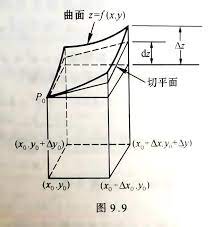
Fundamental theorem of divergence:
$$ \int_\mathcal{V}(\nabla \cdot \bold{v} )dV = \oint_\mathcal{S} \bold{v} \cdot d \bold{S} $$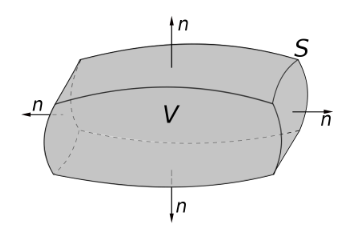
先看通量,右边
-
对一个面$v$ has 3 values
- $v_x(x,y,z)$
- $v_y(x,y,z)$
- $v_z(x,y,z)$
-
Surface vector points out forward of a small volume
这也是散度这么定义的来源
Why $v(x)$ from left to right:
$$ v = v_x \hat{x} + v_y\hat{y} + v_z\hat{z} $$Fundamental theorem of curl:
$$ \int_\mathcal{S} (\nabla \times \bold{v}) \cdot d \bold{S} = \oint_P \bold{v} \cdot d \bold{l} $$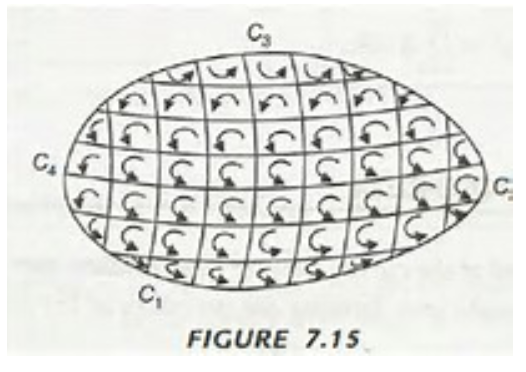
同样从右边看,看一个小的环路的积分,微元加起来,重复的边界 cancel 掉了
Curvilinear Coordinates
Spherical polar coordinates (SPC):
$$ \begin{aligned} x &= r\sin \theta \cos \phi\\ y &= r \sin \theta \sin\phi\\ z &= r \cos \theta \end{aligned} $$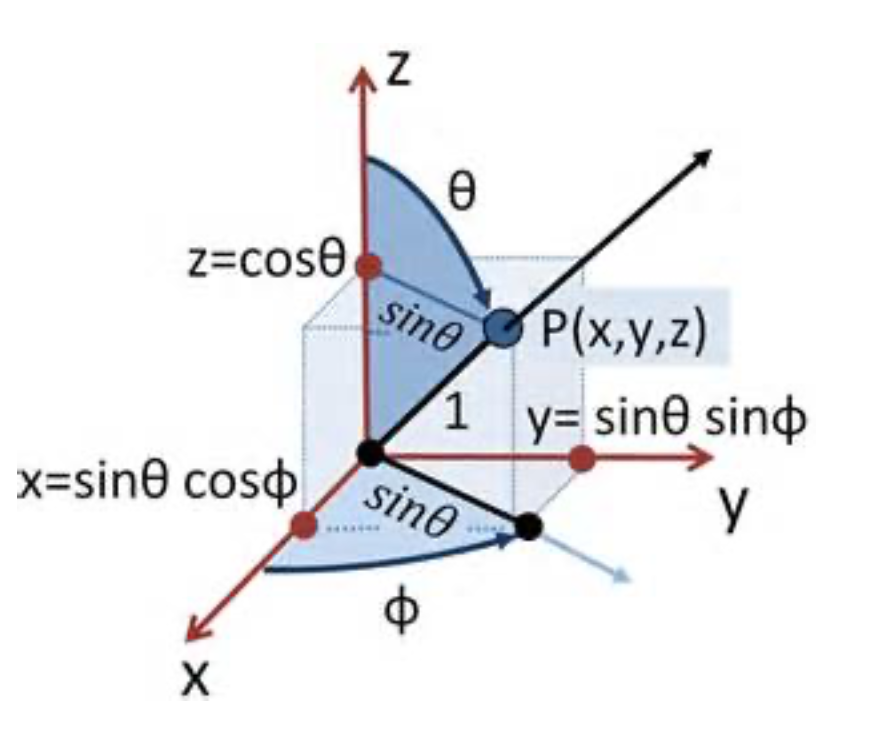
Direction of $\theta$ is increase of theta
Unlike Descartes(笛卡尔) coordinates, the SPC coordinates changes with $r$ ,$\theta$ $\phi$,坐标轴会变。
If we want to calculate the value of infinite small volume, because $\theta$ $\phi$ are not length, we need to 要算体积微元, $dl$ $dl_\theta$ $dl_\phi$
$$ \begin{aligned} dl_r &= dr = h_1 dr\\ dl_\theta &= r d\theta =h_2 d\theta\\ dl_\phi &= r \sin \theta d \phi = h_3 d\phi \end{aligned} $$Here $h_1,h_2,h_3$ are geometrical factors
For Cylindrical coordinates:
- 和$x$ 夹角$\phi$
- $r$投影到$x-y$ 平面长度
- z $$ \begin{aligned} dl_s &= ds = h_1 ds\\ dl_\phi &= s d\phi =h_2 d\phi\\ dl_z &= d z = h_3 dz \end{aligned} $$